Transforming Our Thinking
Eng Mumina Wa-Kyendo is concerned by Africa's poor standing in the world, both socially and economically. He has written a book which postulates that our culture, our collective thinking pattern, is responsible for our dire straits.
The idea of transforming the lives of our people is what motivates Eng Wa-Kyendo to get into national leadership.
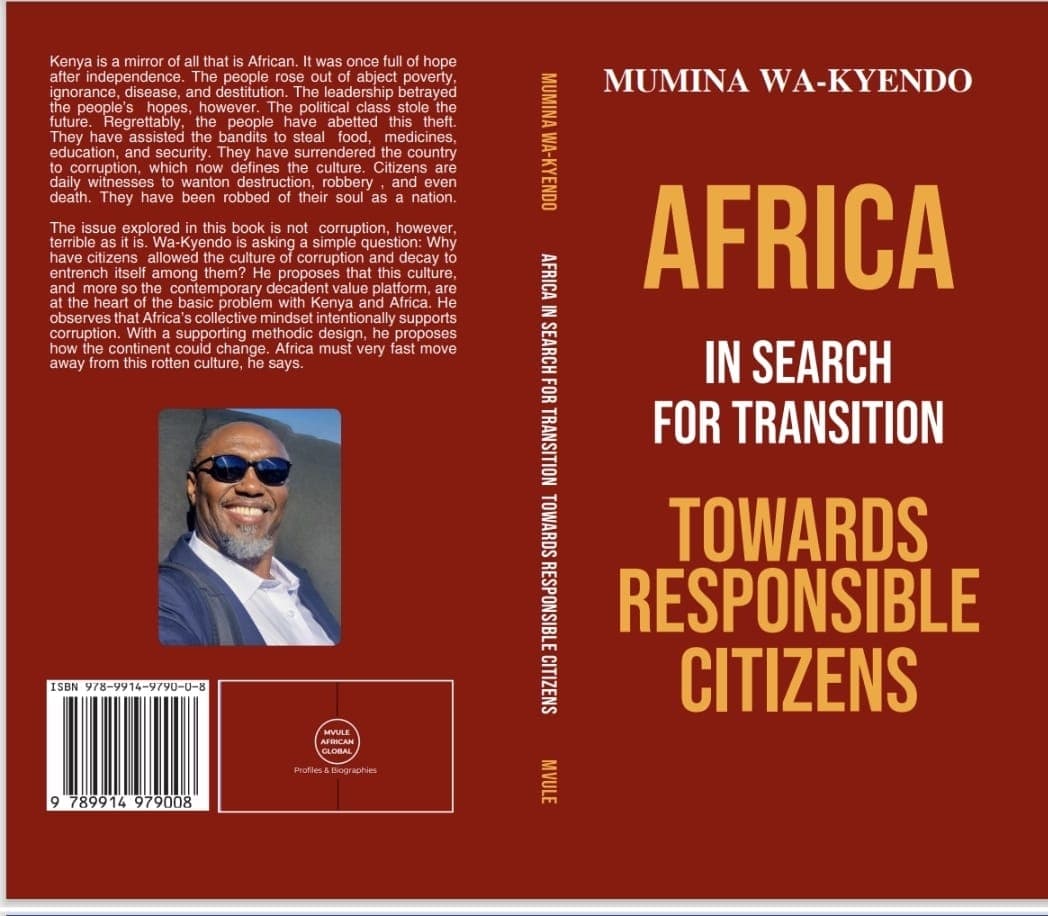
AFRICA — In Search for Transition: Towards Responsible Citizens
By Mumina Wa-Kyendo
This book is the instrument through which we can begin to heal our collective consciousness. It diagnoses the problem at the cultural and psychological level, and points toward the transformation we need.
By reading and discussing this work, we participate in a movement to upgrade our thinking — from the culture of decay toward a culture of responsibility, accountability, and collective flourishing.
What You'll Find Inside:
- •Deep analysis of the broken collective psyche
- •Historical context of our damage and potential healing
- •A vision for cultural transformation
- •Practical framework for Reclaim, Reset, Recreate
- •Call to action for responsible citizenship
AFRICA — In Search for Transition: Towards Responsible Citizens
By Mumina Wa-Kyendo
This book is the instrument through which we can begin to heal our collective consciousness. It diagnoses the problem at the cultural and psychological level, and points toward the transformation we need.
By reading and discussing this work, we participate in a movement to upgrade our thinking — from the culture of decay toward a culture of responsibility, accountability, and collective flourishing.
What You'll Find Inside:
- •Deep analysis of the broken collective psyche
- •Historical context of our damage and potential healing
- •A vision for cultural transformation
- •Practical framework for Reclaim, Reset, Recreate
- •Call to action for responsible citizenship
AFRICA — In Search for Transition: Towards Responsible Citizens
By Mumina Wa-Kyendo
This book is the instrument through which we can begin to heal our collective consciousness. It diagnoses the problem at the cultural and psychological level, and points toward the transformation we need.
By reading and discussing this work, we participate in a movement to upgrade our thinking — from the culture of decay toward a culture of responsibility, accountability, and collective flourishing.
What You'll Find Inside:
- •Deep analysis of the broken collective psyche
- •Historical context of our damage and potential healing
- •A vision for cultural transformation
- •Practical framework for Reclaim, Reset, Recreate
- •Call to action for responsible citizenship
Program Overview
1. IF I COULD DREAM!
A vision for our future
2. Why is the African the poorest here, there, everywhere?
Understanding our challenges
3. How can we help ourselves?
Solutions and pathways forward
4. What I saw when I travelled!
Lessons from around the world
5. Upgrade our culture to version 2.0
The path to transformation
6. The Good, the Bad and the Ugly
Cultural attributes analysis
7. Upgrading the software
Reprogramming our mindset
8. Call to action
What we must do now
9. Strategy To Upgrade our Culture to V. 2.0
Implementation roadmap
IF I COULD DREAM!
If I could ask for a dream, I would.
A dream that, one day, our country will be prosperous, just and peaceful.
If I could dream, I would dream that we would have a leadership that has the wellbeing of the people at the centre. A Leader who would Reclaim this country from the charlatans that have taken us hostage.
If I could dream, I would dream of a government that would Reset Kenya to the times when things worked for the citizens. Was there such a time? A Team that would Recreate this county into the Kenya we want.
But we, Kenyans, cannot help ourselves!
© Mumina Wa-Kyendo 2026
A call to transform our collective thinking, our culture and go on to Reclaim, Reset and Recreate the Mavoko & Kenya we want.
Why is the African the poorest here, there, everywhere?
In my life, I have travelled to many countries in Africa, Europe, America and Asia. I have observed how people live and behave. I have seen similarities in attitudes that make developed countries distinctly different from Africa. This difference and its implications is what I discuss in this section of this book.
The first man was created from the soil, so says all major religions. Because the African skin is the colour of earthen clay, this suggests that Adam was African.
This, however, is not the question I am answering here. The question I am answering is: Why is the African the poorest here, there, everywhere?
Why? Because the African is trapped. He is trapped in the past. He is trapped in his traditions. He is trapped in his beliefs. He is trapped in his own mindset about himself. He sees himself as perpetually poor because that's what his forefathers were. He accepts poverty as his lot. He lives each day trying to get by. There is no hope. There is no dream.
How can we help ourselves?
The way out is to rise above this mentality. First, we must make a decision. We must decide that things will be different. Then we must commit. We must then put in the action. Only then will we rise above our current situation.
But by and large, I believe that most Africans have given up. They wait for the government to do something. They wait for NGOs to come and help them. They wait for the gods to smile upon them. In the meantime, each day more poverty, more hunger, more despair.
I believe change starts from within. It starts from our mind-set, our attitudes, our goals. We need a movement to inspire people, to give them hope, to help them see a better future. We need leaders who can inspire people. People who have risen above the fray, and who can help others to do the same.
What I saw when I travelled!
I have observed that in developed countries, people generally believe in the power of their labour. They believe that through the power of work and dedication, one can achieve their goals. They are also more motivated by the power of the collective. Society as a whole benefits when individuals work to their potential.
In developing countries, and specifically in Africa, people are more motivated by the power of the individual. The attitude is that if I can get my share, others can fend for themselves. This is a self-destructive attitude because it creates an atmosphere of distrust and greed. Soon, corruption sets in, and society collapses.
In developed countries, they often plan long-term. They invest in education, infrastructure, and healthcare, knowing that these investments will benefit society in the long run. In Africa, leaders just think about the here and now. They want to get rich quick. They have no interest in the future of the nation.
Upgrade our culture to version 2.0
That is why I am suggesting that we have to change our culture now. That is why I have a program called Upgrade Africa Culture to version 2.0, UAC2.0. join me as we transform our country and move towards where we want to be.
Culture is a way of life of a given group of people, the totality of how a society thinks, moves, behaves, believes, prospers and relates to itself and to others. It is the entirety of how people live. Words that define culture include civilization, society, morals, background, traditions, ethnicity, customs and ways of life.
Culture is defined as the act of developing intellectual and moral faculties (or abilities) especially through education. Culture is an integrated pattern of human knowledge, belief, and behaviour; and depends on the capacity for learning and transmitting knowledge to succeeding generations. Culture is a set of shared attitudes, values, goals and practices that characterize an institution, or organization.
The Good, the Bad and the Ugly
There are bad cultural attributes that we must identify and leave behind, and there are good cultural attributes that we must identify and learn to practice them. Allow me to present a small part of cultural attributes related to collective goals or objectives.
What are some undesirable attributes in the category of Goals? At local level, elites' goals is to get power, wealth and influence by all means necessary. At international level, elites just want to alleviate poverty, reduce the suffering. They don't care enough to treat the disease and repeal ignorance. They don't talk about creation of wealth for Africa.
At the same time, local elites pursue personal advancement at the expense of society. They have no goal beyond self-aggrandisement. Local middle-class is lost in between the dirt-poor people they despise and the elites they admire and hate with equal measure. In this confusion, their goal is to simply to maintain status quo: don't rock the boat. The local middle class, consisting of educated professionals, are responsible for much of the decay in our society- they know what to do but cannot do it, wouldn't do it, are scared to do and in this posture, they assist, willingly or otherwise, as the elite plunder the country.
For the people, the ones described by some as holoi-poloi, the mwananchi, raia, the downtrodden, the common man, the majority of our people, they have no specific goals - just live day after day. They will be called out to protest this or that, gassed by police, and left to die while the elites who used them rush to State House to make deals.
Upgrading the software
These people, the real voters, are so disfranchised they should be willing to do anything to raise up. This project will give them a voice by turning attention inwards to reprogramme their software. To replace the mwananchi operating system with Mwenyenchi OS.
Call to action….
Over and over again, for 60 years since independence, we have tried to build our nation. Each time we expect better results but deep down we know we are lost. My conclusion is that Kenyans are damaged goods! I believe that our souls have been injured! Our humanity has been degraded, reduced to unacceptable levels! We must stop this madness. We have got to change our culture, our collective way of thinking, our way of doing things, our patterns of behaviour. If it ain't working, fix it!
In here I propose that to fix our state, we must start by transforming our culture. Our culture here does not mean our tribal, or other ways. It's our collective psyche! Our national mindset! We have to exterminate those things we do that are not beneficial to us, and start doing those things that are useful to us as one people. We must believe and act on this fact of faith: the greater good for all of us supersedes individual benefit.
We need to make cultural transformation a subject to be taught in schools and cultural transformation should be mainstreamed in every department in every aspect of work life, until we have acquired superior cultural values that will underpin our development and propel us to prosperity and a dignified way of life.
To achieve this cultural transformation, come with me . . .
Strategy To Upgrade our Culture to V. 2.0
It seems clear that we need to transform our culture, to align it with what we desire. It is time for action. We start by designing what we need to do which is to upgrade African culture to Version 2.0. We shall call this exercise the Upgrade African Culture 2.0 (UAC 2.0).
The implementation strategy is a key input that is most essential for the success of project. We need a mass movement in the digital and physical space to disseminate this knowledge and practices it. The mass movement must have committed leaders and champions. It must reach other people in a self-regenerating fashion. The movement will be educational, teaching people a higher way of life. The strategy must allow the champions to reach the people directly.
The champions will form UAC2.0 Clubs across the country and continent. Champions will come from all social cadres to represent the whole society, from all age groups and genders, every geographical area, every culture and educational background, every business and religion. The movement will train and deploy the champions, who will also become trainers and later trainers of trainers.
We have formed the Real Deal Movement, a community in the social media to kick start this movement. Join the nearest club or contact us so that we can assist you in forming a club. Visit therealdealhum.org website and social media platforms to get help in joining or setting up a UAC2.0 Club.
Join the Conversation
Discussions
Join forums and group discussions about the themes in the book and how they apply to our societies.
Podcasts
Listen to in-depth conversations exploring cultural transformation and collective change.
Streaming Events
Attend live events and workshops on transforming our collective thinking.